Krag Collectors Association Forum Archive
General >> Ammunition, reloading, shooting, etc >> What's going on with this brass?
http://www.kragcollectorsassociation.org/cgi-bin/yabb2/YaBB.pl?num=1439409935

Message started by Texas10 on Aug 12th, 2015 at 8:05pm

Title: What's going on with this brass?
Post by Texas10 on Aug 12th, 2015 at 8:05pm
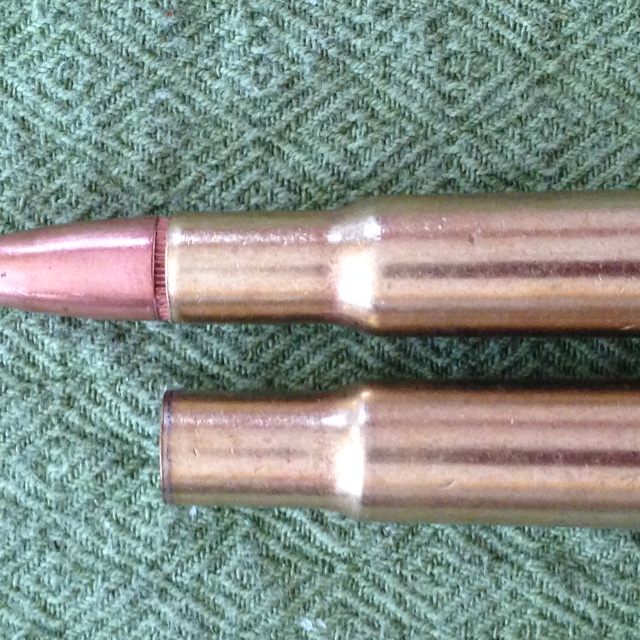
Shot my Krag for first time in decades using Remington and Winchester ammo. Case looks like nothing I've seen before. Almost Ackley improved, or bad chamber ream job. Primers are backing out about .015 too.

I'll post more pictures.

Can I expect these to resize properly or are they too deformed?
Before_and_after_firing.JPG ( 213 KB | 2 Downloads )

Title: Re: What's going on with this brass?
Post by Texas10 on Aug 12th, 2015 at 8:06pm
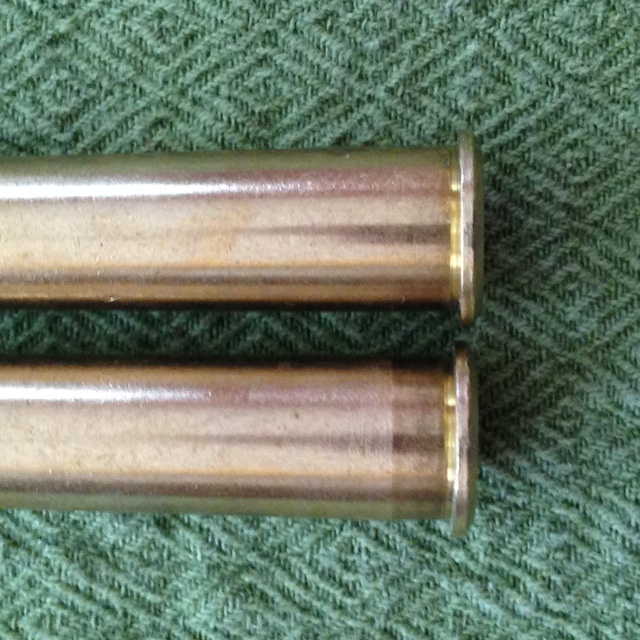
Here's view of the heads.
Base_looks_stretched.JPG ( 181 KB | 2 Downloads )

Title: Re: What's going on with this brass?
Post by Texas10 on Aug 12th, 2015 at 8:07pm
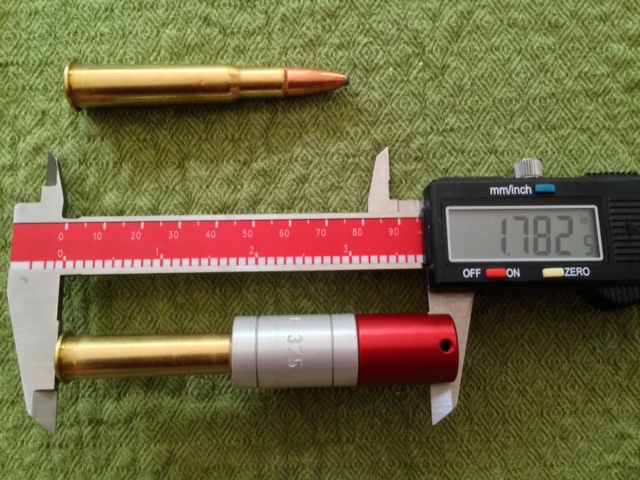
Head to shoulder measurement, new Remington 30-40
New_Rem_cartridge.JPG ( 139 KB | 0 Downloads )

Title: Re: What's going on with this brass?
Post by Texas10 on Aug 12th, 2015 at 8:08pm
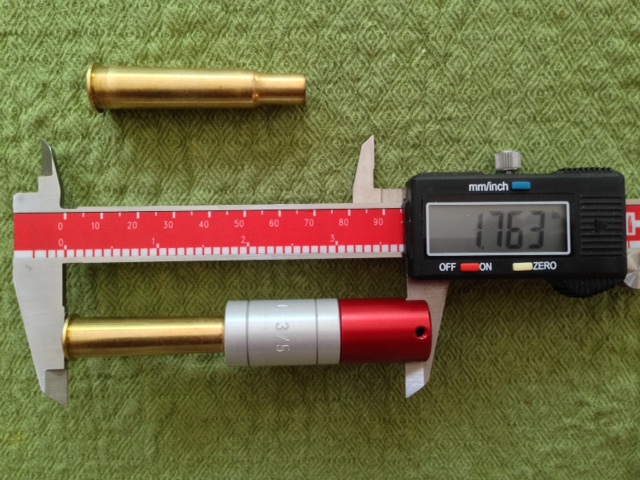
This is once fired measurement.
Once_fired_shoulder_measurement.JPG ( 140 KB | 0 Downloads )

Title: Re: What's going on with this brass?
Post by Texas10 on Aug 12th, 2015 at 8:12pm
I have a set of Lee dies coming and would like to do some reloading. I have about 100 rounds of NIB ammo I've collected recently at gun shows or off the shelf when I see it.

Any suggestions as to what I can expect while reloading would be greatly appreciated.  :)

Title: Re: What's going on with this brass?
Post by butlersrangers on Aug 12th, 2015 at 10:24pm
The .30-40 Krag cartridge 'head-spaces' on its rim. It is normal in necked-rimmed cartridges, like the .30-40 Krag (and even more so with the .303 British), for the factory cartridge case shoulder to 'move forward' and form to the chamber. Your fired cases don't look that unusual to me.

As I have mentioned elsewhere, when you reload your .30-40 brass, back off the F.L. Sizing Die, a turn or two, and neck-size only. There is no point generally in F.L. resizing .30-40 brass if used in one rifle.

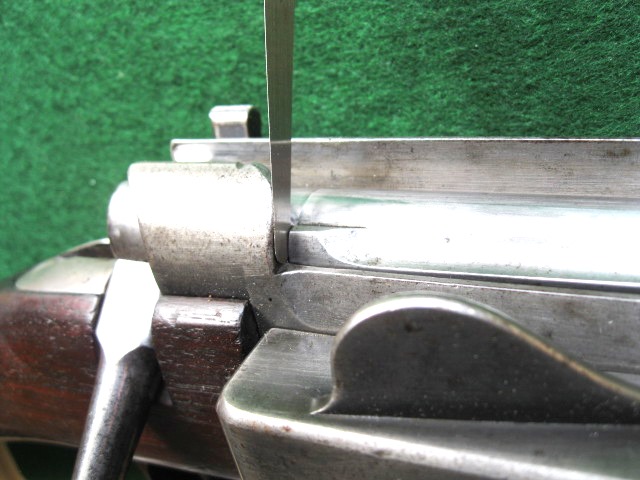
It is possible that the 'gun-smith' who 'Sporterized' your Krag followed an old practice of lapping its locking-lug so that the rear of the bolt guide rib now makes contact with the receiver, when the bolt is closed.

This practice was believed at the time to strengthen the action. (As built by Springfield, the bolt guide rib has a few thousandths clearance at the rear).

The practice of lapping the Krag bolt lug for this contact increased 'head-space' by a few thousandths. (Unissued replacement bolts are available for $55 on ebay and will tighten up 'head-space').

Testing the bolt fit in the receiver requires just using the bolt (with out striker assembly). 
krg-98blt-1.JPG ( 87 KB | 1 Download )

Title: Re: What's going on with this brass?
Post by Parashooter on Aug 13th, 2015 at 12:27am

Texas10 wrote on Aug 12th, 2015 at 8:06pm:
Here's view of the heads.
  (You need to Login

I suspect you're misinterpreting the difference in surface texture between the portion of the case that has expanded to contact the chamber and the solid head that doesn't expand to contact. This is completely normal and benign.

  (You need to Login

This visual effect should not be confused with the thin "bright ring" indicating the case wall has stretched somewhere ahead of the web/wall junction.

  (You need to Login
Incipient head separations (and a USGI extractor at right).

Title: Re: What's going on with this brass?
Post by psteinmayer on Aug 13th, 2015 at 11:06am
+1 on both Chuck's and Para's assessment.  All of my brass looks pretty much like yours, and I've reloaded and fired most of my brass in excess of ten times (some closer to 20 loadings).  The biggest problem I'm starting to see is necks cracking and splitting now.  Also, don't confuse a primer that looks like it contacted metal with one that is truly backed out and flattened.  My primers routinely look like they've been hit with a rough faced hammer... but never flatten.  I suspect that this is because my headspace is nice and tight, and the minor pressure that my primers see moves them a hair until they contact the bolt face.

When you start reloading, anneal the necks and shoulders of your brass (heat the neck and shoulder of the brass until the color changes slightly and then allow it to cool).  This will help the brass to stay a little more malleable, and extend the life considerably.  Also, as Chuck mentioned, back your sizing die out 1 turn or more so that you're only neck sizing.  Finally, never exceed established load manual pressures.  I usually stay right about in the middle of the road.  Your Krag should provide another hundred years or more of good clean fun!

Title: Re: What's going on with this brass?
Post by Texas10 on Aug 13th, 2015 at 11:26am
Thank you Butlersranger for schooling me on the differences of a rimmed cartridge vs. a rimless. I was loving the way it was shooting, but hating what I was seeing after ejecting the brass. I did notice the bolt rib to reciever contact you mentioned, so you're probably right about what the "funsmith" did to the bolt. BTW: That's a great picture you provided. Thanks for taking the time to do that.
I did check Ebay after your post and found plenty of Krag bolts on the market. Something to consider.
I prefer neck sizing only when loading for my bolt guns, and the lee dies I have for my 223 include a neck size only die, so I am hoping the Krag set will also include one. If not, I'll do as you suggest.

Thanks again for sharing your valuable experience.

Title: Re: What's going on with this brass?
Post by Texas10 on Aug 13th, 2015 at 11:33am
Parashooter, you're right about the head markings. About the time you were writing, I was re-measuring and found that case had expanded forward of the case-web junction just as you mention. So feeling better about that now.
The fired cases did stretch about 15 thou. as measured base to mouth, so trimming may be in order before I reload. With only neck sizing, I may have to do this only once.

BTW: GREAT pics!


Thanks for your timely advise. I feel much better now about shooting my antique. ;)

Title: Re: What's going on with this brass?
Post by Texas10 on Aug 13th, 2015 at 11:45am
Psteinmayer, I appreciate you're taking the time to write. I am seeing my primers are backed out 10-15 thou. They don't look particularly flatted, just backed out. Not sure what to make of that. There does not appear to be a crimp mark on the heads so they must have thought it not necessary. Maybe that is a requirement only for ammo shot from semi-autos.

Could this be due in part  the result of my not cleaning all the oil out of the chamber and the brass not gripping the chamber wall enough? Not sure of the mechanics of a rimmed cartridge when it comes to primers backing out.


Title: Headspace basics
Post by Parashooter on Aug 13th, 2015 at 1:37pm
Several generations of American shooters have been convinced by bad information that something called "headspace" should be checked and re-checked on almost any vintage rifle. The truth is less interesting but still worth knowing.

Stripped to its essentials, with a rimmed cartridge like the .30/40, headspace is simply the distance between the face of the bolt and the back of the barrel. It's the space where the "head" (rim) of the cartridge fits when the rifle is loaded.

  (You need to Login

Since there has to be some room to allow for varying rim thickness, the headspace is normally a bit more than necessary - giving what we call "end play" or "head clearance", a little extra space so the bolt can close easily, even on the thickest rim allowed.

When a full-power cartridge is fired, a whole string of events occurs.

  (You need to Login

1. The firing pin shoves the case forward, rim against the breech.
2. The primer detonates. If it's not heavily crimped in place, it backs out, shoving the bolt and barrel as far apart as it can.
3. The thin, forward part of the case expands to fill and grip the chamber while the bullet moves out of the case and down the barrel.
4. The solid case head can't expand and grip the chamber, so it moves rearward, re-seating the primer, stretching the case walls just forward of the head, and stopping when it hits the bolt face. (If pressure is low, primers may be left protruding.)
5. If (and only if) the amount of head movement exceeds the elastic limits of the case, the cartridge separates into two pieces.

New cartridge cases can normally stretch a lot before breaking. Even with a minimum rim .054" thick and maximum "field" headspace of .074", the resultant .020" end play is well within the limits of new brass and it's very unlikely a new case will separate even if the headspace is somewhat more than the field maximum (which is pretty rare, especially in Krags.)

Title: Headspace basics, continued
Post by Parashooter on Aug 13th, 2015 at 1:42pm
OK, but if one does separate we're in deep trouble, right? Not really. It seems the short "cup" left behind the break is pretty good at keeping most of the gas where it belongs. Here's a quote from Hatcher's Notebook -

". . . With good strong actions and moderate pressure loads, and especially if the shooting glasses are worn, this trouble is not particularly dangerous, but is annoying and inconvenient. Very little, if any, gas escapes to the rear, because the back end of the cartridge, which remains in the chamber, acts as a seal. In fact, it is just such short brass cups that the Germans have for years used as the breech seals in their heavy artillery . . .

"Our riflemen are used to measuring the headspace of their rifles by thousandths, and are prone to become very much alarmed if the headspace gauges two or three thousandths of an inch more than the normal maximum. This is a good safe attitude to take, but it is something like measuring cordwood with a micrometer. . ."

If you handload for a US Krag with generous headspace, there's no need to mess with bolt swapping - changing the rifle's clearances to yield longer case life. You can control cartridge end play simply by changing technique.

When you fire a new case for the first time, use an improvised spacer ahead of the rim - anything from a precision metal washer to dental floss can work to hold the the cartridge head firmly against the bolt face and eliminate or reduce stretch even if head clearance is significant. Such techniques are useful only if the rifle has excess headspace. With normal headspace, initial stretch isn't enough to worry about.

  (You need to Login

After you've fire-formed your new cases they will fill the chamber fully, stopping on the shoulder just like a rimless cartridge. If you neck size, you'll have zero "headspace". If you have to full length size, adjust the die so the cases chamber with just a bit of resistance in the last few degrees of bolt rotation. Cases fitted this way and fired with moderate loads can last for dozens of loading cycles. 

Title: Re: What's going on with this brass?
Post by Parashooter on Aug 13th, 2015 at 2:12pm
See more of the same at   (You need to Login

Title: Re: What's going on with this brass?
Post by butlersrangers on Aug 13th, 2015 at 2:25pm
'Parashooter': As always - Great explanations and graphics! Thanks.

P.S. - IIRC - A primer projecting to the rear that has maintained its rounded corners ('cup-shape' and not flattened), can be a sign of low pressure in rounds. On Firing, the primer was pushed back to take up 'free play', but, there was not enough pressure to stretch the cartridge case and force the case-head rearward against the bolt face (which would have re-seated the fired primer).

IMHO - If there is no evidence of gas leaking from or stretching primer pockets and cartridge cases are not separating, the brass is doing its job. Use the cases as fire-formed. Just trim brass as needed and Neck-Size.

Title: Re: What's going on with this brass?
Post by luvmy40 on Aug 13th, 2015 at 3:16pm

Texas10 wrote on Aug 12th, 2015 at 8:12pm:
I have a set of Lee dies coming and would like to do some reloading. I have about 100 rounds of NIB ammo I've collected recently at gun shows or off the shelf when I see it.

Any suggestions as to what I can expect while reloading would be greatly appreciated.  :)


The Lee set does not come with a neck sizer. They(Lee)don't make a neck sizer for the 30-40 as a stock item. I assume they will custom make a die to your specs but you can get a bushing neck sizer die from HC-4D   (You need to Login

Though as others have said, I get good results just backing the full length die off a bit.

Title: Re: What's going on with this brass?
Post by Texas10 on Aug 13th, 2015 at 5:35pm
Fantastic explanation, Parashooter. Best I've ever seen! And the graphics were extraordinarily well done. Thank you, thank you, thank you! The rimmed case headspace is rarely explained in detail in modern manuals. My 1949 Lee manual is better, but still...

Of the ten rounds I shot this week, 5 Remington, 5 Winchester, all ejected with primers backed out about ten thou or so, and all were flattened except the 4 Rems that I reduced the load by 3 gr. Those still had nice rounded edges.
Both the Rem and Win are loaded to full case and at least slightly compressed loads.

I am planning to hand load my neck sized only brass per Hornaday manual using 3031 or 4320 which I have in stock, and 150 gr. v-max, but not sure if I should use magnum primers.

Now, I don't want anyone to stick their necks out un-necessarily, but I would like to ask for some advice..

As I wrote above, I did reduce the loads of the first four rounds I fired, AGAINST THE ADVICE I was offered, and I wanted to explain that.

I've been hand loading for only about a year, but I've been doing it with a lot of research done beforehand, logging everything, keeping targets, x-cell spreadsheets, etc. Trying to be scientific about it and not just hap-hazard.

I've hand loaded about 2000 rounds to date and have achieved some ridiculously small groups out of my 223, which, as you probably know, is perhaps the easiest round to load.

So my question is, was I taking a big risk in reducing loads by 3 grams (typo, that should be grains) and assuming it was safe to shoot?

The results were as I expected, but perhaps that was pure luck, so feel free to ream me if I screwed the pooch on that. Might help to keep me safe and around longer so I can pester you mercilessly with more questions. ;D

Title: Re: What's going on with this brass?
Post by butlersrangers on Aug 13th, 2015 at 9:39pm
'Texas10': I think you meant to say reduced powder weight by three Grains (not Grams).

In regard to safety, I don't rightly know. I do not know what propellant was used in the old Factory Loads, that you reduced.

From what I have read over the years, DETONATIONS occur with reduced loads of slow burning powders.

IMHO - A safer course for you, would have been to dump the original powder charge, instead of reducing it, and replace it with a starting load of a known propellant, like IMR-3031, IMR-4064, or IMR-4895.

Title: Re: What's going on with this brass?
Post by Parashooter on Aug 13th, 2015 at 9:57pm

Texas10 wrote on Aug 13th, 2015 at 5:35pm:
So my question is, was I taking a big risk in reducing loads by 3 grams and assuming it was safe to shoot?

If you reduce a typical .30/40 load by 3 grams (46.3 grains), you'll have no powder in the case. Be sure not to confuse grams and grains. Different systems.

You'll continue to see protruding primers until you put in enough powder to expand the case fully. With 150-grain bullets, that may require about 40 grains of 3031. Once the case is expanded to fit, neck or partial FL sizing can maintain minimal cartridge end play, eliminating primer protrusion even with lighter loads.

Title: Re: What's going on with this brass?
Post by Keith Herrington on Aug 13th, 2015 at 10:03pm

Texas10 wrote on Aug 12th, 2015 at 8:08pm:
This is once fired measurement.


Your measurement is .002" shorter than what my fired brass measures.  Pretty darn close.  Now measure neck dia., shoulder dia. and dia. at the gas ring (near the rim where the texture of the brass changes on a fired case).  Post measurements so we can compare to ours.
Keith

Title: Re: What's going on with this brass?
Post by Texas10 on Aug 13th, 2015 at 10:34pm
I grabbed 3 of the Winchester brass. The necks measured .340 at the mouth, .423 to .424 at the shoulder, and .455 about .200 above the rim.

And yes, that grams reference was a typo. Should be grains.  ::)

Title: Re: What's going on with this brass?
Post by psteinmayer on Aug 14th, 2015 at 10:59am
As far as I know, if they were factory loads, they should have already been loaded to safe levels for use in a Krag.  Remington and Winchester ammo has always been manufactured to acceptable velocities and pressures.  I would shoot any remaining factory rounds as-is. 

Another handy tidbit for reloading:  If you're concerned about your primers moving, use some primer sealant.  I loaded some Italian Ordnance 10.4 mm brass that was converted Berdan primed.  This very rare round has no current production ammo or brass... so I converted old (but good condition) Berdan cases to accept Boxer primers.  The primers were slightly looser than they would have been had the cases originally been Boxer.  I used good primer sealant, and since this was an old Italian revolver with very tight headspace, I was confident they would be safe... and I was right - the sealant really did the trick and the primers never moved!  I now use primer sealant on all of my rifle ammo, Krags included.

Title: Re: What's going on with this brass?
Post by RichWIS on Aug 14th, 2015 at 12:53pm
I believe Hornady makes a sort of universal 30 cal neck sizing die.  The die is available from most suppliers(if in stock).  If you have a 308 Win die you can use that, Install die with about a 1/4 inch clearance from the shell holder and run a case into it.  You will see an obvious line where it stopped sizing the neck.  Adjust until sizing stops at the juncture of neck and shoulder.  A FL die works, the 308 case is fatter and will not contact the sides of the case.  Backing out your FL die until it just sizes the neck will work also.  The advice about annealing is spot on, it is easy to do and will extend case life, an issue since as you have found brass for a Krag is not easy to come by.

Title: Re: What's going on with this brass?
Post by Keith Herrington on Aug 14th, 2015 at 1:48pm

Texas10 wrote on Aug 13th, 2015 at 10:34pm:
I grabbed 3 of the Winchester brass. The necks measured .340 at the mouth, .423 to .424 at the shoulder, and .455 about .200 above the rim.

And yes, that grams reference was a typo. Should be grains.  ::)


My measurements are as follows:

Fired Brass
Neck dia.    .340"
Length at Shoulder using .375" collet    1.784"
Shoulder dia.   .422"
Gasring dia.    .456"

Sized brass using my Hornady sizing die modified to take an Redding Neck Bushing (.333")
Neck dia.  .333"
Length at Shoulder using .375" collet    1.780" (could set it tighter if needed)
Shoulder dia.   .419"
Gasring dia.    .453"

Bottom line:  your measurements are spot on.  If you want a sizing die modified as mine, let me know.
keith.herrington@aol.com

Title: Re: What's going on with this brass?
Post by butlersrangers on Aug 14th, 2015 at 3:12pm
'RichWIS' - gave a good suggestion about using a .308 Winchester F.L. Sizing Die to Neck-Size .30-40 Brass.

Keith - confirmed your fired Brass is dimensionally typical for 'once fired Krag brass'.

The .30-40 Case Neck is quite long. It is not necessary to Re-size the entire case-neck, especially if reloading 130 to 165 grain bullets. With lighter projectiles, you may have to seat bullets Out, as far as practical, to have your reloads feed through the Krag action.

I am not a 'Precision Bench Rest Shooter' (BR does not appeal to me). I am a Military Match shooter. I have gotten good results from my Krags using Standard Dies, Neck-Sizing, using 'starting loads' of IMR-3031 & IMR-4895 with 180 grain and lighter jacketed spitzer projectiles (to keep pressures low), and standard large rifle primers (Winchester).

The .30-40 U.S. Army has been around a long time and is fun, accurate and easy to reload. There is a wealth of Data on this cartridge.

Title: Re: What's going on with this brass?
Post by Keith Herrington on Aug 14th, 2015 at 8:59pm

butlersrangers wrote on Aug 14th, 2015 at 3:12pm:
I am not a 'Precision Bench Rest Shooter' (BR does not appeal to me). I am a Military Match shooter. I have gotten good results from my Krags using Standard Dies, Neck-Sizing, using 'starting loads' of IMR-3031 & IMR-4895 with 180 grain and lighter jacketed spitzer projectiles (to keep pressures low), and standard large rifle primers (Winchester).


Quite understand your comment.  My efforts to get the "perfect" sizing die revolves more around reducing runout than anything else.  However, I've not only done that but gotten superb dimensionality as well.  I don't really know how much "accuracy" I'm gaining from my efforts, but by nature I'm a precision rifle shooter and reloader.  I shoot better knowing that my ammo it the best I can produce.  Spending a few bucks on these dies was money well spent in my opinion, and easy to do if anyone else is interested.

Title: Re: What's going on with this brass?
Post by psteinmayer on Aug 14th, 2015 at 10:23pm
I applaud your efforts Keith.  I'm sure you'll knock us all dead at Perry next year.

For me, it's more about the fun of loading and shooting in the matches.  The Krag has been around for over a hundred years... and shooters have been successfully reloading, taking record game, and winning matches ever since... and doing it using simple tools and equipment to load, so I'm going to keep that tradition alive.  I use a standard Lee FL sizing die backed out 1 full turn to neck size.  I load 220 gr Hornady RN bullets over 40.0 grains of IMR-4350 and a CCI 250 Magnum primer, and I do alright with it... for me anyways!

Title: Re: What's going on with this brass?
Post by butlersrangers on Aug 14th, 2015 at 10:27pm
Keith - I'm not knocking the persuit of perfection. As you state, there are different valid approaches to Reloading and not every minor variable effects accuracy at the target. Keeping it fun is important.

One old extra-step I use: 1. Start the bullet slightly into the case-mouth with the Seating Die. 2. Back-off the Die and rotate the case about 90 degrees in the shell-holder. Seat the projectile to about half its seating depth. 3. Back-off the Seating-Die pressure. Rotate the case another 90 degrees and then complete the bullet seating stroke.

I do this quickly & automatically, and it improves bullet concentricity with the cartridge case.

Title: Re: What's going on with this brass?
Post by Keith Herrington on Aug 15th, 2015 at 9:58am
Yup, I've tried that method in regular seating dies and you can get good results.  But my consistency using that method was never as good as I wanted it.  Now that I've got case runout down to below .002", the runout of my loaded rounds rarely exceed .004".  When they do I just set them aside for practice.  Something to remember.  The newer the brass, the less all this seems to matter.  But I'm now on my second loading.  As time goes on and I use these 500 cases over and over again, I think (I hope) these steps I take will be increasingly worthwhile.  But, only time will tell.  In any case, I've had a ton of fun "solving" this problem.

Title: Re: What's going on with this brass?
Post by Texas10 on Sep 5th, 2015 at 10:27pm
Lot's of great information guys, it'll take a while to sink in as i try different approaches. I bought a set of lee FL sizing dies and will try the neck only approach for now, just because that is what I do for my 223 brass.

I'll start trying some hand loads in the next few weeks and let you know how it goes. Still have not decided on a bullet/powder combination to start with.

BTW: is that H4350?

Thanks again for all the help. This should be a lot of fun!

Title: Re: What's going on with this brass?
Post by psteinmayer on Sep 6th, 2015 at 12:36pm
H4350 and IMR4350 are very close... but slightly different in burn rate.  Most reloading manuals will state whether the data is for IMR, Hogdon, Accurate, etc., and you will see a difference.  When consulting your load tables, make sure you are using data for IMR4350 if you're using IMR powder, H4350 data if using Hogdon powder, etc. - and you won't go wrong.  FWIW, I use IMR4350 in my Krag competition loads.

Title: Re: What's going on with this brass?
Post by S.B. on Sep 20th, 2015 at 2:29pm
Another great read! Great knowledge and experience is evident here.
thanks, Steve

Krag Collectors Association Forum Archive » Powered by YaBB 2.6.0!
YaBB Forum Software © 2000-2026. All Rights Reserved.